Why Does Pizza Dough Shrink When You Stretch It? Here’s How to Fix It
You’ve made your pizza dough, let it rise and are ready to shape your pizza. But as soon as you start stretching it, the dough pulls back and becomes smaller again.
The main reason pizza dough shrinks when you stretch it is gluten.
When flour and water are mixed together, proteins in the flour form gluten. Kneading and folding the dough develop a network of gluten proteins that gives pizza dough its structure and elasticity.
This is essential for making good pizza. Gluten helps the dough hold its shape and trap the gas produced during fermentation. But there is a downside: the more you work the dough, the more tension can build up in the gluten network.
If you try to stretch pizza dough immediately after kneading, dividing or shaping it, that tension can make the dough pull back. Instead of staying stretched, it contracts and becomes smaller. When you stretch the dough, you are stretching its gluten network. If the gluten is still tense, it naturally tries to return to its previous shape.
This is why you might stretch your dough into a larger circle only to watch it shrink back a few seconds later. It doesn’t necessarily mean there is something wrong with the dough. It may simply need more time to relax.
How Long Should Pizza Dough Rest Before Stretching?
If your pizza dough keeps shrinking when you stretch it, the easiest solution is to let it rest.=
Cover the dough and leave it undisturbed for around 10–20 minutes, then try stretching it again. If it is still very resistant and keeps shrinking, give it more time.
The exact resting time depends on the recipe, flour, hydration, fermentation process and temperature of the dough.
For this reason, there isn’t one universal resting time that works for every pizza dough.
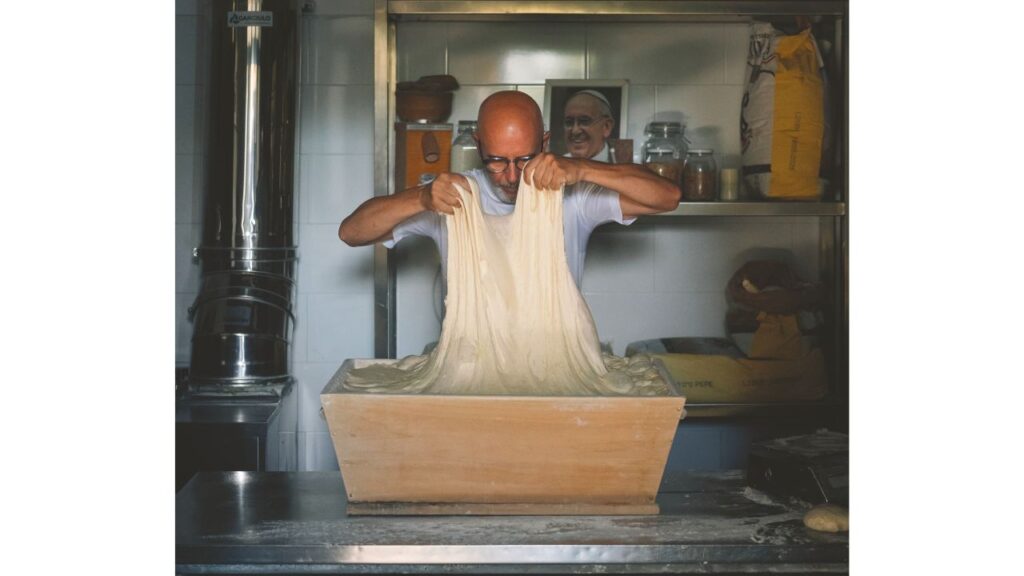
Franco Pepe with dough. Photo by Adam Bricker and Brian McGinn.
Why Does Resting Make Pizza Dough More Stretchy?
Resting allows the gluten network to relax.
Immediately after the dough has been worked, the gluten structure can be tight and resistant. During rest, that tension gradually decreases, making the dough more extensible.
In other words, the dough becomes easier to stretch without constantly pulling itself back.
This is also why pizza makers often allow individual dough balls to rest after dividing and shaping them. The dough needs time to become relaxed enough to open into a pizza.
Does Cold Pizza Dough Shrink More?
Temperature can also affect how pizza dough behaves.
Cold pizza dough is generally firmer and less extensible than dough that has warmed up. If you take dough directly from the refrigerator and try to stretch it, it may feel tight and resistant.
Allowing refrigerated dough to come closer to room temperature before shaping can make it easier to stretch.
However, dough temperature is only one part of the equation. Gluten development, hydration and fermentation also affect how extensible the dough is.
Stretching Pizza Dough Takes Patience
Pizza dough needs more than just the right ingredients. Time is an important part of the process.
When pizza dough shrinks as you stretch it, it is often a sign that the gluten network is still tense. Resting gives the dough time to relax, making it more extensible and easier to shape.
So, if your pizza dough keeps shrinking, don’t fight it. Let it rest, then try again.
Food Meets Science is gathering place to connect all food lovers from all over the world and create a community of all those for whom food and science is passion.